Late last week State Auditor Dave Boliek released a scathing audit of the Town of Cary, filled with reckless spending in recent years.
The full 2,600 page report can be read here.
Some of the notable findings from Boliek’s audit:
- A total of 828 procurement cards were issued to town employees, or 62% of the town’s workforce. These procurement cards registered over 60,000 transactions for $24.2 million
- Ten pairs of Ray-Ban sunglasses were purchased for $1,600.
- Former town manager Sean Stegall purchased two properties totaling over $1 million without notifying members of Cary’s town council ahead of time
- A ghostwriter was paid $65,653 to write a book praising Stegall’s leadership
- Over $120,000 spent on a video production for a town retreat in 2024. Production resulted in a documentary about staff performing a choreographed dance inspired by the musical “Mamma Mia!” and Swedish pop group ABBA, which can be viewed here.
The Office of State Auditor determined that during this time period the Town of Cary’s Fund Balance fell below the minimum level of 33.33% in FY 2023 and FY 2024.
The Town of Cary’s official response to State Auditor Boliek’s report includes several indications that the town is not prepared to implement best practices for responsible government spending and management. The Town of Cary instead sought to place all blame on former Town Manager Sean Stegall.
Excerpts from the Town of Cary’s response:
“In 2016, Sean Stegall was hired as Town Manager. As a self-described change agent, he introduced private-sector thinking and ways of doing business that differed from Cary’s past and from most other North Carolina cities and towns.”
“[Stegall] practiced a philosophy of limiting and/or reducing headcount. This went too far and created an understaffed and overworked organization. In some circumstances, this resulted in eroding expertise among staff, especially in highly technical areas. In other cases, shorthanded teams felt forced to work quickly and seek the most efficient options, feeling pressured to pay convenience or other fees just to “get it done.”
The Town of Cary’s eagerness to blame wasteful government spending on “private-sector thinking” and “reducing headcount” echoes frequent allegations about conservative governing philosophies. However, Cary is a municipality exclusively run by liberals and progressives.
Cary joins other poorly managed municipalities that have demonstrated consistent poor planning and spending. Last summer, Wake County Public School System (WCPSS) was found to have a $200 million backlog in HVAC maintenance, which resulted in over 60 schools being closed or dismissed early due to extreme temperatures. This $200 million backlog happened despite $172.8 million being sent from the federal government to address the HVAC maintenance issues. Not a single penny of the $172.8 million in federal funds was spent to address the HVAC backlog, with nearly all of it being spent on employee salaries and benefits.
Nearly a year later, WCPSS has three schools in need of structural repairs before students can return. Durant Road Elementary School students are being forced to use a completely different school when their year round schedule begins.
In September of last year Winston-Salem/Forsyth County Schools faced a $46.1 million budget deficit, which resulted in hundreds of employees losing their jobs. In 2022-23 school year Winston-Salem/Forsyth County Schools gave out $75 million in bonuses to employees.
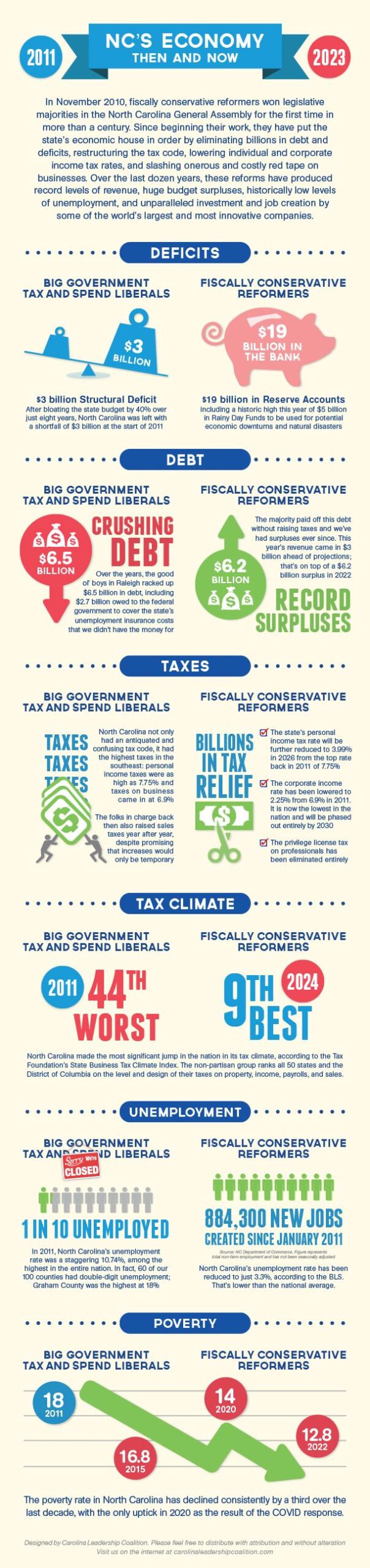
Instead of blaming “private-sector thinking” the Town of Cary could look to a model of government spending and management just a few miles down the road at the North Carolina General Assembly that has consistently delivered results for the people of North Carolina the last 16 years.
In the 2000s, a liberal governing philosophy at the state level left taxpayers with some of the region’s highest taxes to cover unaccountable, reckless spending. When the 2008 recession hit, so did layoffs, furloughs, and salary freezes.
And instead of tightening their belt and getting spending under control, the Town of Cary chose to raise taxes just a few weeks ago.
This out of touch tax-and-spend policy is yet another reason why voters overwhelmingly favor a constitutional amendment to place levy limits on property tax increases by municipalities.